
Grapevine Previous Residents Sources
A backward address trail moves across eras and custodians. For a newer parcel, the appraisal record supplies the account, legal description, subdivision, block, lot, and instrument references needed to find a recorded deed. When a modern address disappears from the record, Tarrant deed-history cards, tax rolls, library microfilm, and archival ledgers can bridge the gap. The source date matters as much as the name. An owner shown in a recorded instrument is not necessarily the person who occupied the site.
| Source | Years or period | Where held | Address-history value |
|---|---|---|---|
| Official Records Search | Current portal; exact earliest online-image cutoff not located | Tarrant County Clerk | Recorded parties, dates, document numbers, legal phrases, and images when offered. |
| Deed-history cards | 1876-1984 | Tarrant County tax deed-history search | Property-history bridge using subdivision, block, lot, abstract, or grantee fields. |
| Grapevine and Dallas directories | Grapevine 1972; Dallas 1955-1962 and 1964-1996 | Grapevine Library and other libraries | Printed address or telephone-directory leads for selected years. |
| Tax rolls and census microfilm | Tarrant tax rolls 1850-1910; census reels vary by series | Grapevine Genealogy Room | Owner, assessment, and household context in historical material. |
| County archival ledgers | Land and property ledgers, undated and 1897-1917 | Tarrant County Archives | Earlier property material when the standard index trail ends. |
Begin with the most recent documented parcel reference and only then move backward. Tarrant County does not conduct a title or lien search, so the index identifies documents to inspect rather than supplying a conclusion. Note: write down the custodian, URL, access date, and record identifier beside every finding.
Grapevine Previous Residents Deed Trail
The most reliable backbone for past-household research is a chain of recorded property transfers. Tarrant Appraisal District can show the current parcel account and legal description. The Tarrant County Clerk's Official Records Search can then be queried by party, grantor, grantee, document number, book or volume or page, legal phrase, and date. A grantor is the person or entity transferring an interest. A grantee is the person or entity receiving it. Those roles make the backward sequence possible.
- Open the Tarrant Appraisal District property search and capture the account, current owner display, instrument reference, subdivision, block, lot, and legal description.
- Search the Tarrant County Official Records index for the current grantee, document number, legal phrase, or recorded date. Save the linked image or copy reference when available.
- Read the instrument. Record the parties, recording date, execution date if shown, document number, book or page reference, and exact legal description.
- Use the seller from that transfer as a grantee in an earlier search. Repeat the sequence, checking whether the legal description still refers to the same parcel.
- When the modern index no longer reaches the needed era, use deed-history cards, historic ledgers, tax rolls, county archives, library microfilm, and map resources.
- Chain of title
- A sequence of recorded transfers associated with the same legal parcel, read backward from a later document.
- Legal description
- The subdivision, block, lot, survey, abstract, or metes-and-bounds language that defines land more steadily than a street number.
- Instrument number
- The record identifier used to locate the recorded document or request a copy from the county clerk.
Grapevine Deed-History Card Clues
Deed-history cards are the Tarrant County bridge for property history from 1876 to 1984. Their search page accepts Subdivision Name, Subdivision Code, Block Number and Lot Group, or Abstract Number and Grantee. It is especially useful when a street address was not yet used in the modern form. The card route belongs in a Grapevine address-history search after the current deed trail has been tied to a stable legal description.
Insider tip: the grantee format is LAST, FIRST, the subdivision code must be exact, an abstract number cannot begin with A, and browser popups must be enabled. Those small requirements can explain an empty result. Keep the original spelling from the deed before trying variants.
The Tarrant deed-history-card search provides the specialized fields used for this older address route.
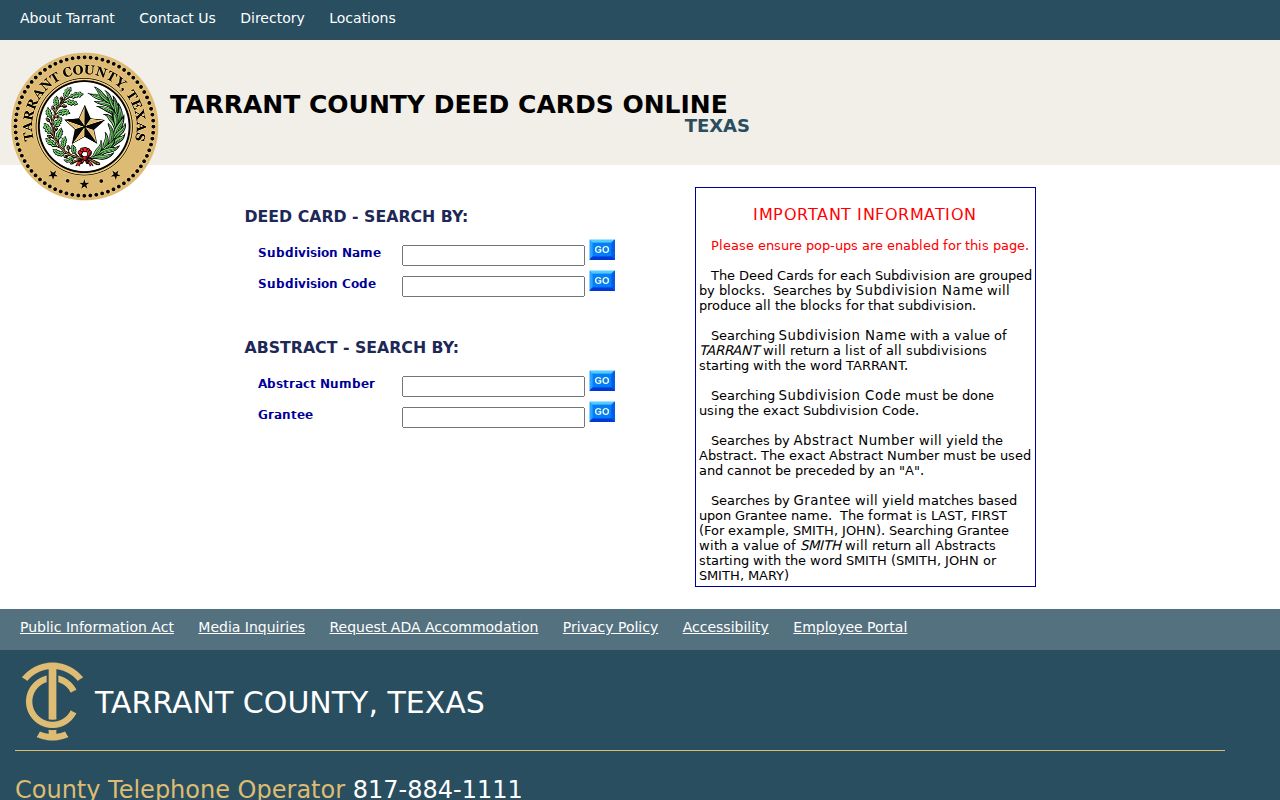
Use the returned property-history reference as a lead, then confirm its legal description and related recorded documents with the proper custodian.
Grapevine Past Residents Address Changes
An older address may fail because the street changed, not because the property has no history. In 1924, Grapevine annexed College Heights, Berry's Lane, and western property that included the Yancey residence on Grapevine or Keller Road, now West Wall. Morehead Street became Texas Street. Historic district records also use Main, College, Wall, Dallas Road, Dooley, and Scribner as place keys. Normalize a search with old and current names, directionals, street types, district labels, and landmarks.
The legal description remains the anchor. Compare city historic-district maps, Tarrant GIS, and the 1885 Tarrant County map against subdivision or abstract terms in a deed. The tax route is another way to cross-check the property key. Tarrant Tax Office accepts account number, owner address, and owner name searches, but it is distinct from both the appraisal record and the recorded-deed index.
The Tarrant County tax search offers the account and owner-address route that can help reconcile an older property reference.
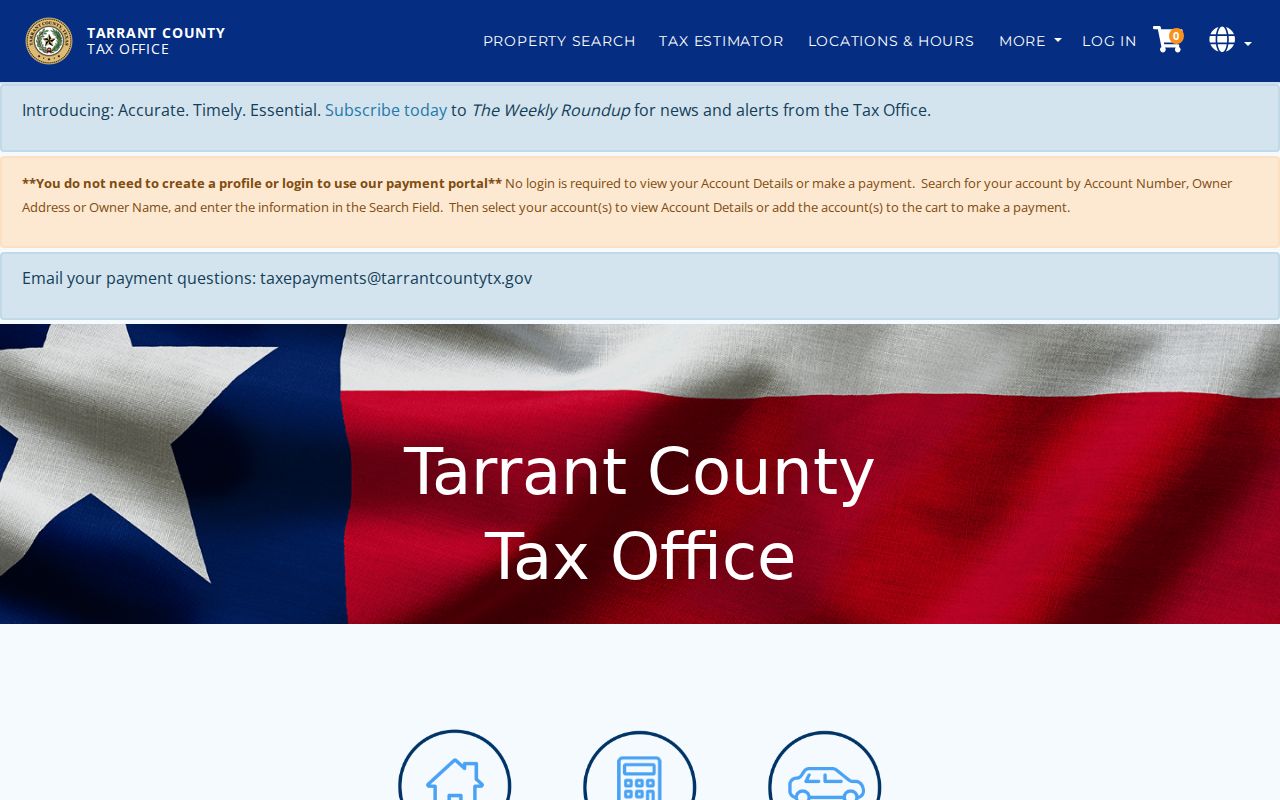
Match a tax result to the appraisal account and legal description instead of relying on a familiar street label alone.
Grapevine Household History Layer
Recorded ownership is only one layer. For a household lead, use the known directory years and library material without promising a continuous local run. Grapevine confirms one known city directory, from 1972. Dallas Public Library telephone directories include Grapevine entries for 1955 through 1962 and 1964 through 1996, while greater-Fort-Worth directories do not include Grapevine. A missing directory entry can reflect the collection's limits rather than a person's absence.
- Start with the 1972 Grapevine directory if the address or person falls in that year, then compare the selected Dallas telephone-directory volumes.
- Preserve the printed address exactly and test its old street-name form against the deed or map trail.
- Pair a directory date with available federal census material, tax rolls, and local newspapers rather than assuming one source identifies every household member.
- Use Grapevine Sun, which survives on microfilm from 1898 through its final 2009 issue with gaps, to check move, obituary, land-sale, and civic context.
- Consult the Genealogy Room readers or contact its staff to confirm a reel or volume before making a trip.
The full scope of these scarce volumes and microfilm tools is kept with the Grapevine City Directories collections. The Genealogy Room also holds Tarrant tax rolls from 1850 to 1910 and numerous federal census reels. Treat a directory, census, or newspaper find as dated evidence, then compare it with the parcel and document trail. Note: the 1890 federal census is mostly destroyed, so that gap needs other records.
Grapevine Records After the Fire
Myth: a missing early county record proves that no event occurred. Tarrant County Archives and Footprints report that a courthouse fire on March 29, 1876 destroyed or severely damaged virtually all records. Some marriage material survives through late returns, but the loss is a real research gap. For an early Grapevine family or parcel, widen the trail to tax rolls, newspapers, church and cemetery records, land grants, surviving marriage returns, and probate substitutes.
Tarrant County's digitized historic ledgers add a practical next step. The archive describes civil-court ledgers from 1871 to 1959, land records that are undated or span 1897 to 1908, and property material from 1876 to 1917. Handwritten fields need visual inspection even where a PDF has searchable text. Call the archives before treating an unlocated record as a permanent absence, because it holds more than 600 collections but not every county record.
The Tarrant County historic-ledgers collection is a documented fallback once the normal previous residents path reaches its early boundary.
Ledger material can supply a dated property lead, but it still needs comparison with the legal description, map, and surviving recorded documents.
Grapevine Permit Date Markers
City development material can bracket a property event when the deed trail alone is thin. Grapevine reports that permits and Certificates of Occupancy are updated in the Report Center, with code-enforcement reports there as well. WebLink can be browsed and searched for development material. A permit, certificate, or report may tie a project and date to the address, which can direct a researcher to a newspaper issue, a deed interval, or an older map.
Do not convert an applicant or project name into a claim of occupancy. If an existing city record is not available in a public interface, send a written Texas Public Information Act request to the City Secretary with a narrow address, date range, and document type. Grapevine accepts written requests by email, the public-information portal, fax, mail, or in person. Note: city project files supplement a parcel history but do not replace the county deed record.
Grapevine Address-History Limits
Past-household research should preserve the meaning of each source. A deed identifies a recorded transaction or interest, not a complete list of occupants. An appraisal card can show a primary owner mailing field that differs from the property address. A directory volume can omit a household, and a newspaper can have gaps. City and county boundaries also need care: DFW Airport has a large Grapevine footprint, and Lake Grapevine was annexed in Denton County, so a geographic label can point to different custodians.
Use official records for family history, estate or heir research, property history, and verification of a public filing. Ask the record custodian about redaction, correction, or access rules. Texas confidentiality protections can limit disclosure, and an absence may be a privacy result rather than proof that a person was not connected to the address.
Lawful use. Trace past Grapevine households with restraint and respect for privacy. Never use a historic or current address result to stalk, harass, threaten, or harm any person.